

Table of Contents
- What Counts as Construction Debris
- C&D Waste Recycling Requirements in Ventura County
- Dumpster Rental vs. Full-Service Hauling: Which Works for Your Project
- How Construction Debris Removal Works
- Construction Debris Disposal Cost and What Affects Your Bill
- Common Mistakes to Avoid When Removing Construction Debris
- Why Same-Day Removal Matters for Job Sites and Renovations
- Conclusion
- Frequently Asked Questions
Last Updated: September 21, 2026
What Counts as Construction Debris
Construction debris removal in Ventura County encompasses lumber, roofing materials, asphalt, drywall, insulation, flooring, fixtures, and metals from renovation and demolition projects, far more than just broken drywall and concrete chunks.
Different materials require different disposal pathways. Hazardous materials like asbestos, lead paint, and certain sealants demand specialized handling and cannot go into standard construction debris removal streams. Sorting debris at the source saves time and money.
Proper debris management prevents injury from loose nails, sharp edges, and unstable piles. Professional crews understand load distribution, weight limits, and secure containment, details homeowners often overlook in DIY construction debris removal.
Before scheduling construction debris removal, walk your site and photograph what needs to go. This gives the crew an accurate picture and prevents quote surprises when they arrive.
C&D Waste Recycling Requirements in Ventura County
California Code of Regulations Title 14 requires contractors and property owners to divert a minimum percentage of C&D waste from landfills through recycling facilities and material recovery operations.
Individual Ventura County cities impose their own standards. The City of Ojai requires 75% waste diversion documentation for demolition projects over 1,000 square feet; the City of Thousand Oaks enforces similar thresholds. Verify your jurisdiction’s diversion rate before debris removal begins to prevent delays and fines.
Materials Accepted at Regional Recycling Facilities
Recycling facilities across the region accept sorted materials in these categories:
- Concrete and asphalt: Crushed and reused as aggregate or road base
- Wood: Chipped for mulch, animal bedding, or energy recovery
- Metals (ferrous and non-ferrous): Separated and sold to scrap processors
- Cardboard and paper: Baled and sent to paper mills
- Gypsum drywall: Processed separately to prevent contamination of other streams
- Roofing materials: Asphalt shingles accepted at dedicated facilities; metal roofing sorted with ferrous metals
Mixed loads incur higher fees or rejection. Pre-sorting on-site reduces processing costs and ensures materials reach the correct end-market at transfer stations and recycling centers.
Hazardous Waste Protocols and Testing Requirements
Hazardous materials require certified disposal at approved facilities. Testing may be required before removal on structures built before 1980. The EPA and California DTSC regulate these materials; improper disposal carries fines up to $10,000 per violation and potential criminal liability.
Common hazardous materials found in older construction include:
- Asbestos: Insulation, floor tiles, roofing, pipe wrap, joint compound (pre-1980)
- Lead paint: Interior and exterior coatings (pre-1978)
- PCBs: Electrical equipment, caulk, sealants (pre-1979)
- Mold and biological hazards: Wet insulation, contaminated wood
If your structure predates 1980, assume hazardous materials are present. Testing typically costs $300-$800 but prevents costly disposal violations and protects crew health.
Assuming all construction debris can go to the landfill is a costly mistake. Ventura County jurisdictions enforce waste diversion requirements, and violations can result in project holds or fines up to $10,000. Hazardous materials improperly disposed carry additional penalties. Verify local requirements and conduct material testing before the debris hits your property.
Dumpster Rental vs. Full-Service Hauling: Which Works for Your Project
Choose between renting a roll-off dumpster and hiring full-service construction debris removal based on project scope, timeline, and labor availability.
Roll-off dumpster rental works well for multi-week renovations where debris accumulates gradually. You control the schedule and load at your pace; the rental company picks up when full. You handle all loading yourself.
Full-service hauling means a crew arrives, loads everything, and hauls it away, often same-day. This works better for quick turnarounds, estate cleanouts, and demolition projects. The crew handles sorting, loading, and transport; the trade-off is less flexibility and higher per-job costs.
Consider labor costs too. If your crew is already on-site and loading is part of their workflow, a dumpster makes sense. If you’re paying hourly workers to stand around while debris gets loaded, full-service hauling often costs less in total labor spend.
Junk Jedis offers same-day full-service construction debris removal across Ventura County, handling the entire process from loading to disposal, eliminating the need for you to manage multiple vendors or waste streams.
| Approach | Best For | Setup Time | Labor Required | Cost Structure |
|---|---|---|---|---|
| Roll-off Dumpster | Multi-week projects, gradual debris | 1-2 days | High (you load) | Per-day rental + disposal fee |
| Full-Service Hauling | Quick turnarounds, demolition, estates | Same-day available | Minimal (crew loads) | Per-job flat rate |
How Construction Debris Removal Works
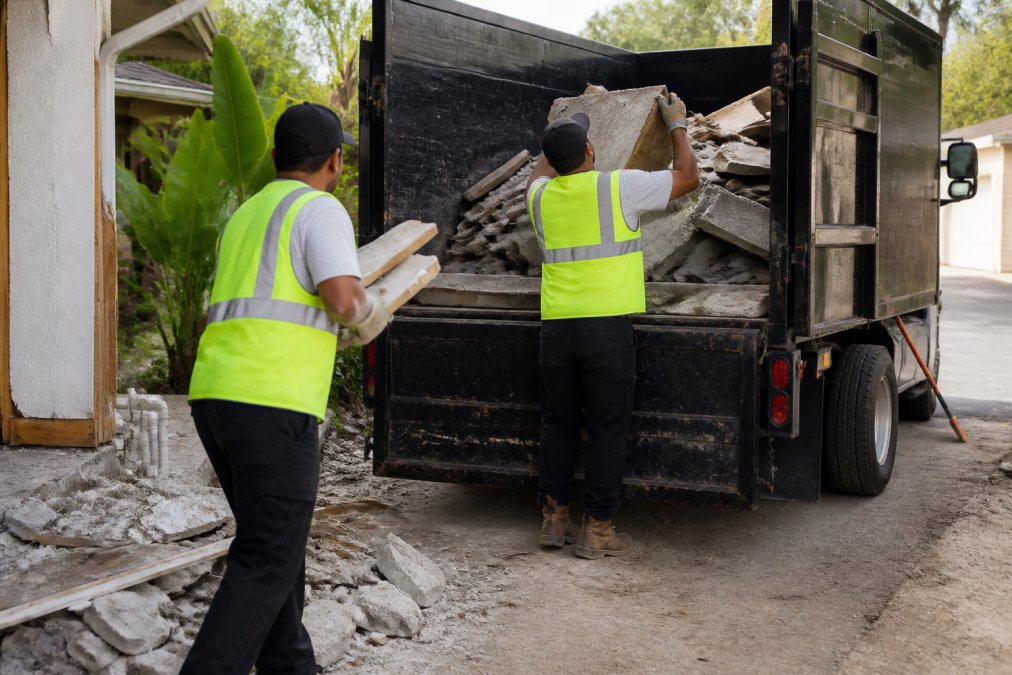
The crew surveys the site, estimates volume, and determines loading sequence. This prevents surprises and ensures proper equipment.
Sorting separates recyclable materials, wood, metal, concrete, and cardboard from general debris, reducing landfill volume and disposal costs.
Proper loading maximizes truck capacity and safety: heavy items like concrete go to the bottom, lighter materials on top. Securing the load prevents spillage and property damage.
Transport routes debris to recycling centers, transfer stations, or specialized facilities for hazardous waste. The crew handles all routing and documentation.
Materials are processed at their respective facilities. Recycled content becomes new products; remaining waste goes to permitted landfills.
Construction Debris Disposal Cost and What Affects Your Bill
Pricing depends on volume, material type, accessibility, and local disposal fees. Understanding these drivers lets you estimate a rough budget before requesting quotes.
Volume and Weight-Based Pricing
Volume is the primary driver. Most services charge by the load or weight. Roll-off dumpsters hold 10-40 cubic yards; full-service trucks handle 8-15 tons per load.
For rough estimation purposes:
- Concrete and asphalt: 1.5-2.5 tons per cubic yard (heaviest materials)
- Mixed construction debris: 0.75-1.5 tons per cubic yard
- Wood, drywall, and light materials: 0.5-1 ton per cubic yard
If your project generates 5 cubic yards of mixed debris, expect roughly 3.75-7.5 tons. A single full-service haul might handle this; a dumpster rental might require a second pickup. Disposal fees at transfer stations typically range from $40-$120 per ton, depending on material type and facility. Recycling facilities often charge less ($20-$60 per ton) or offer credits for sorted, high-value materials like metals.
Material Composition and Hazardous Material Surcharges
Material composition affects cost significantly. Standard construction debris (drywall, wood, concrete) follows baseline pricing. Hazardous materials require certified disposal, which costs substantially more:
- Asbestos removal and disposal: $1,000-$3,000+ (includes testing, containment, certified hauling, and facility fees)
- Lead-painted materials: $500-$2,000+ (depends on surface area and containment requirements)
- Mixed hazardous waste: $2,000-$5,000+ (requires specialized facility and documentation)
If your structure predates 1980, budget for testing ($300-$800) and hazardous material surcharges. Mixing hazardous materials with general debris can result in the entire load being rejected or reclassified as hazardous waste, multiplying costs.
Accessibility and Labor Factors
Accessibility matters. Second-floor, basement, or distant debris increases labor costs. Tight job sites or limited parking may incur additional fees ($200-$500) for extended setup or traffic control.
Labor costs vary by region and crew size.
Local Disposal Fees and Recycling Credits
Cost Estimation Worksheet
To rough-estimate your debris removal cost:
- Measure or estimate volume: Length × Width × Height (in feet) ÷ 27 = cubic yards
- Estimate material composition: What percentage is concrete, wood, drywall, metal, mixed?
- Calculate approximate weight: Use the ranges above (0.5-2.5 tons per cubic yard)
- Check for hazardous materials: Pre-1980 structures likely contain asbestos or lead; budget $500-$3,000 for testing and certified disposal
- Add accessibility factor: Ground-level access = baseline; second floor or tight site = add 20-40%
- Apply local tipping fees: $40-$120 per ton for disposal, $20-$60 per ton for recycling
- Request formal quotes: Use your estimate to validate quotes and catch outliers
Example: 500 sq ft Bathroom Renovation
Get multiple quotes and ask what’s included: loading, sorting, transport, and disposal. Transparent pricing means no surprises when the job is done. Use this worksheet to validate estimates and identify outliers.
Common Mistakes to Avoid When Removing Construction Debris
Underestimating volume leads to multiple trips or unexpected charges. Walk your site with a tape measure and photograph everything that needs to go.
Why Same-Day Removal Matters for Job Sites and Renovations
Same-day construction debris removal keeps projects moving. When debris sits on-site, it blocks access, creates safety hazards, and slows the next phase of work.
Contractors managing multiple job sites, property managers handling rapid turnovers, and homeowners who need debris gone today to keep renovations on schedule.
Conclusion
Construction debris removal in Ventura County isn’t just about hauling trash, it’s about keeping your project on schedule, meeting regulatory requirements, and protecting your property and crew. Understanding what qualifies as construction debris, sorting materials properly, and choosing a removal method that fits your timeline saves money and prevents delays.
Frequently Asked Questions
What items are classified as construction and demolition (C&D) debris?
Construction and demolition debris includes drywall, concrete, asphalt, lumber, roofing materials, brick, metals, and fixtures removed during renovation or demolition projects. Hazardous materials like asbestos, lead paint, and contaminated soil are NOT standard C&D debris and require specialized handling. Before scheduling removal, identify what you have, some items need separate disposal methods to comply with local regulations.
Are there specific recycling mandates for construction waste in Ventura County?
Yes. California’s Construction and Demolition Waste Recycling Law requires that at least 65% of C&D debris be diverted from landfills through recycling or reuse. Ventura County facilities enforce these mandates through waste transfer stations and certified recycling centers. Professional removal services can assist with proper disposal to help you meet legal requirements.
How much does construction debris removal cost in Ventura County?
Construction debris removal pricing depends on the volume of debris, type of materials, distance to recycling facilities, and whether you need same-day service. Factors like drywall, concrete, and mixed loads affect the final bill. Junk Jedis provides free estimates so you know the exact cost before work begins, no surprise fees once the crew arrives. Visit the pricing page or call for a quote tailored to your specific job.
Can I put construction debris in my regular curbside trash bin?
No. Most waste management services prohibit construction debris in curbside bins. Heavy materials like concrete and drywall exceed weight limits, damage collection trucks, and violate local disposal codes. Construction debris must go to licensed waste transfer stations or be hauled by certified removal services. Using curbside bins for C&D waste can result in fines and service suspension, so professional removal protects you legally and keeps your property compliant.
Ready to clear your construction debris and keep your project moving? Junk Jedis delivers same-day construction debris removal with free estimates, transparent pricing, and proper waste diversion across Ventura County. Call (844) 424-5334 today to schedule your removal and get back to work.